Foot pain guide
Foot Pain, Tight Calves, and Plantar Fasciitis: Why Your Feet Might Not Be the Whole Problem
Foot pain and plantar fasciitis-type symptoms can involve tight calves, Achilles tension, hamstrings, hips, and low back tension. Here's what to book.
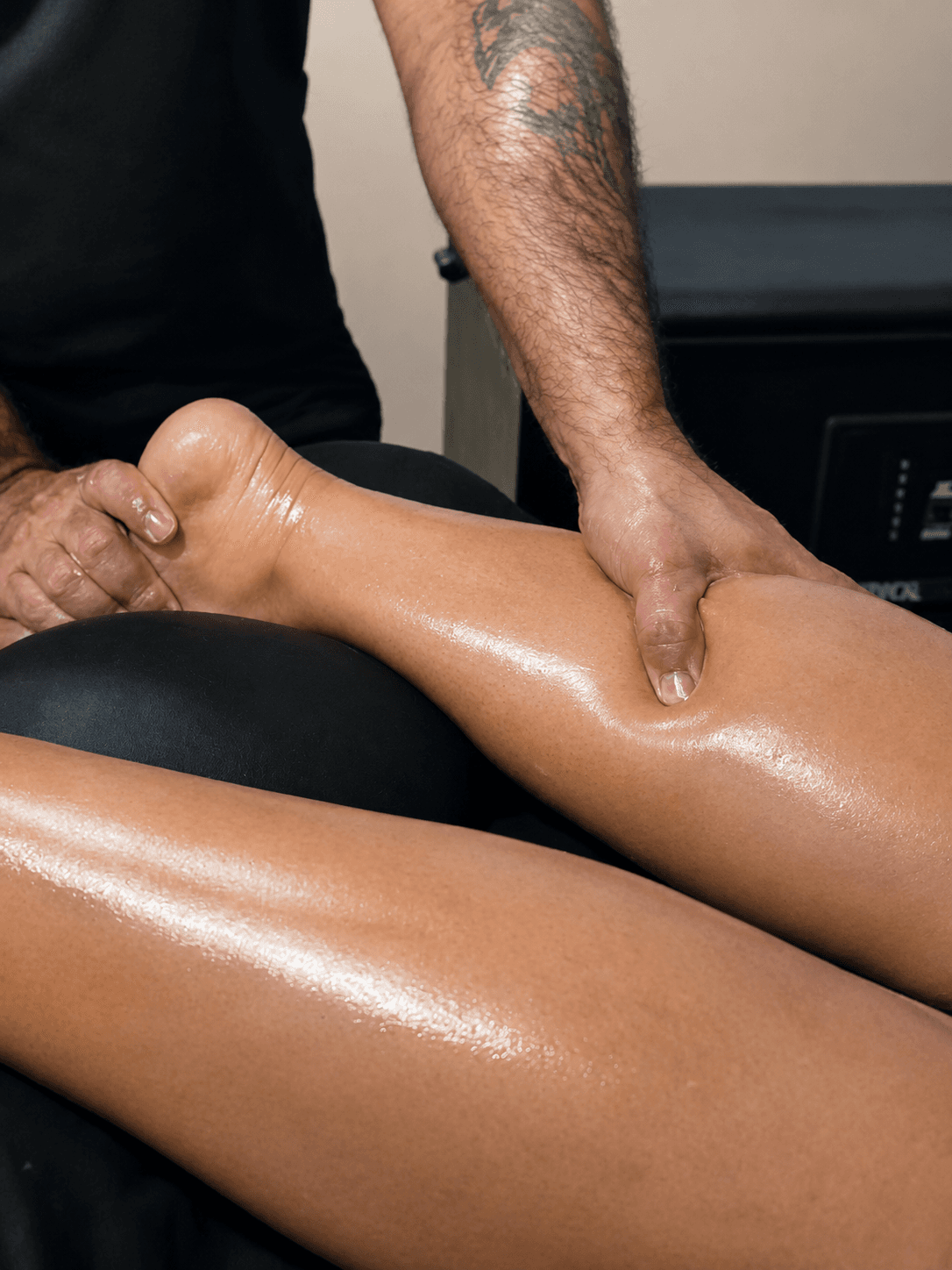
Foot pain can make you feel ancient fast.
You step out of bed and your heel immediately files a complaint. Your arches feel tight. Your calves feel like cables. Your feet ache after standing, walking, working, lifting, running, or wearing shoes that looked better than they functioned.
Then you do the classic human thing: you ignore it and hope your feet stop being dramatic.
Sometimes that works. A lot of the time, it doesn't.
Foot pain is frustrating because it doesn't always start and end in the foot. The sore spot might be under your heel or through your arch, but the tension feeding into it can involve the calves, Achilles tendon, hamstrings, hips, and low back.
That doesn't mean every foot problem is secretly a back problem. It also doesn't mean massage magically fixes plantar fasciitis. That would be a bold little lie, and we're not doing that.
But if your feet hurt and your calves, hamstrings, hips, or low back are also tight, it might be worth looking at the whole lower-body chain instead of only rubbing the bottom of your foot for five minutes and calling it a recovery plan.
At Muscle Movement & Improvement, Chris works with clients who come in for foot pain, calf tightness, plantar fasciitis-type symptoms, lower-body tension, and work-related soreness from standing or moving all day. The goal isn't to diagnose your foot. The goal is to use focused bodywork to address tight, overworked, guarded muscles that might be contributing to how your feet and lower body feel.
Here's what to know.
What plantar fasciitis usually feels like
Plantar fasciitis is one of the most common causes of heel pain.
Mayo Clinic describes it as pain involving the plantar fascia, the thick band of tissue that runs across the bottom of the foot and connects the heel bone to the toes. It often causes stabbing pain near the heel and is usually worst with the first few steps after waking up.
You can read Mayo's overview here: Mayo Clinic: Plantar fasciitis symptoms and causes.
Common plantar fasciitis symptoms might include:
- Stabbing heel pain
- Pain near the bottom of the heel
- Pain that's worse with the first steps in the morning
- Pain after sitting for a while and then standing
- Pain after long periods of standing
- Arch tightness
- Foot stiffness
- Heel pain that gets irritated after activity
A lot of people describe it as feeling like they stepped on a nail, a bruise, or a sharp spot under the heel.
Very charming. Extremely rude.
Why your calves matter when your feet hurt
Your calf muscles connect into the Achilles tendon, which connects to the heel. When your calves are tight, your ankles and feet might not move as freely. That can increase strain through the lower leg and foot.
That's why plantar fasciitis advice so often includes calf stretching, Achilles stretching, and plantar fascia stretching.
Mayo Clinic shows stretches for the calf and plantar fascia here: Mayo Clinic: Exercises to help prevent plantar fasciitis.
Cleveland Clinic also includes calf stretches and foot massage among exercises that might help plantar fasciitis pain and stiffness: Cleveland Clinic: Plantar fasciitis stretches and exercises.
If your calves are chronically tight, your feet might keep taking extra stress.
This can happen if you:
- Stand all day
- Walk on hard surfaces
- Wear unsupportive shoes
- Run or train
- Drive for long periods
- Sleep with your toes pointed down
- Have limited ankle mobility
- Work a physical job
- Suddenly increase activity
- Avoid stretching because, well, life
Foot pain isn't always just about the foot. Sometimes the calves are quietly involved, and they've been getting away with it because the heel is louder.
Why hamstrings, hips, and low back can join the party
Your lower body works as a chain, whether that's convenient or not.
Your feet affect your calves. Your calves affect your knees. Your hamstrings and hips affect how your pelvis and low back move. Your low back can affect how you stand, brace, walk, and compensate.
That doesn't mean every case of plantar fasciitis requires full-body detective work. But if your feet hurt and your calves, hamstrings, hips, and low back are all tight, it makes sense to look beyond the arch.
For example:
- Tight calves can affect ankle movement
- Tight hamstrings can feed into posterior-chain tension
- Tight hips can change how you stand and walk
- Low back tension can change how you load your legs
- Foot pain can make you compensate, which can irritate everything else
The body doesn't care that you wanted this to be simple.
That's why a lower-body-focused massage might include work on the feet, calves, hamstrings, glutes, hips, and low back depending on what you're feeling. Learn more here: Sports Massage in Kansas City.
What massage can and can't do for foot pain
Massage can help when muscle tightness, tension, soreness, or guarding is part of the problem.
For foot pain, that might include focused work on:
- The plantar fascia area
- The arch
- The heel area
- Calves
- Achilles-adjacent tissue
- Hamstrings
- Glutes
- Hips
- Low back
Massage can help the area feel less tight, support mobility, reduce the feeling of muscular tension, and help your body calm down from constant bracing.
But massage doesn't replace medical care.
Massage can't diagnose plantar fasciitis. It can't fix every cause of heel pain. It can't correct a fracture, nerve issue, inflammatory condition, severe injury, or structural problem that needs a medical provider.
If your foot pain is severe, worsening, numb, burning, spreading, injury-related, or not improving, get evaluated by a healthcare provider.
For treatment options, Mayo Clinic lists common conservative options like stretching and icing, and also notes that physical therapy, night splints, orthotics, and other treatments might be used depending on the case: Mayo Clinic: Plantar fasciitis diagnosis and treatment.
Why only rubbing the foot might not be enough
A foot massage can feel amazing. No argument there.
But if the calves are tight, the Achilles feels stiff, the hamstrings are short, and the hips are locked up, only working the bottom of the foot might be a temporary patch.
That's why Chris might work more than the sore spot.
A lower-body session might include:
- Foot and arch work
- Calf work
- Achilles-area work
- Hamstring work
- Glute and hip work
- Low back work
- Stretching or mobility-focused work
- Deep tissue where appropriate
- Trigger point work where needed
The point is to address the connected areas that might be adding tension to the system.
That matters most for people who stand, walk, lift, climb, drive, train, or work on their feet all day. Learn more here: Massage for Manual Labor Recovery.
Foot pain from standing all day
Standing all day is brutal on the feet and legs.
Teachers, nurses, hair stylists, servers, warehouse workers, contractors, cleaners, healthcare workers, retail workers, and tradespeople know this well. By the end of the day, your feet hurt, calves feel tight, hips feel cranky, and your low back might join in because apparently everybody needed to be involved.
Massage can help when that soreness is tied to overworked muscles and lower-body tension.
A session might focus on:
- Feet
- Calves
- Hamstrings
- Hips
- Glutes
- Low back
If standing is part of your job, 90 minutes might be a better fit than 30 because there are usually multiple areas involved. Your feet might be the complaint department, but your calves and hips might be the actual management problem.
Foot pain from running, lifting, or training
Athletes and active adults can also deal with plantar fasciitis-type pain, tight calves, and lower-leg tension.
Running, jumping, lifting, hill work, court sports, and sudden increases in activity can all irritate the foot and lower leg. Sometimes people increase training too fast. Sometimes shoes are worn out. Sometimes recovery is lacking. Sometimes the calves are just tighter than they should be.
Sports massage can help support recovery when the issue is related to tight muscles, training load, or lower-body tension.
Learn more here: Sports Massage in Kansas City.
Foot pain from shoes
Shoes matter.
Unsupportive shoes, worn-out shoes, high heels, shoes with poor cushioning, and shoes that don't match your activity can all contribute to foot irritation.
Massage can help the tight muscles feel better, but if the shoe problem stays the same, your feet might keep getting mad.
Here's where common sense has to be rude.
If your feet hurt every time you wear a certain pair of shoes, the shoes are probably not innocent.
Cleveland Clinic's plantar fasciitis overview discusses risk factors and common care options here: Cleveland Clinic: Plantar fasciitis.
What can you do at home?
Home care depends on the cause and severity of the pain, but a few basic options are commonly recommended for plantar fasciitis-type discomfort.
These might include:
- Resting from activities that flare it up
- Icing the painful area
- Rolling the foot on a frozen water bottle
- Stretching the calves
- Stretching the plantar fascia
- Wearing supportive shoes
- Avoiding barefoot hard-floor walking if it aggravates symptoms
- Gradually increasing activity instead of jumping back in
- Seeing a healthcare provider if symptoms persist
Mayo Clinic mentions using a cloth-covered ice pack or rolling a frozen water bottle over the area as options to help reduce pain and swelling: Mayo Clinic: Plantar fasciitis diagnosis and treatment.
Washington University Orthopedics also shows plantar fasciitis exercises, including toe extension and deep massage along the arch: Washington University Orthopedics: Plantar Fasciitis Exercises.
The big thing is consistency. Doing one calf stretch once and declaring your body unreasonable isn't exactly a plan.
When to see a doctor or physical therapist
Foot pain deserves medical attention if it's severe, getting worse, injury-related, or not improving.
You should consider seeing a healthcare provider if:
- Pain is sharp or severe
- Pain doesn't improve with basic care
- You can't walk normally
- You have swelling, redness, warmth, or bruising
- You have numbness, tingling, or burning
- Pain started after an injury
- Pain is worse at night
- You have diabetes or circulation issues
- Symptoms keep returning
- You're changing how you walk to avoid pain
If you have plantar fasciitis, a doctor, podiatrist, or physical therapist might recommend stretches, strengthening, shoe changes, orthotics, night splints, physical therapy, imaging if needed, or other treatments.
Massage can be part of your care routine, but it shouldn't be your only plan if the issue is persistent or worsening.
Should you book 30, 60, or 90 minutes?
It depends on how much of your lower body is involved.
Book 30 minutes if:
- Your foot pain is mild
- You want focused work on the feet and calves
- You only have one or two problem areas
- You need a quick tune-up
Thirty minutes can be useful for focused foot and calf work, but it's limited. View session and package pricing.
Book 60 minutes if:
- It's your first session
- You have foot pain plus calf tightness
- You want lower-leg work without rushing
- You have one main problem with a few connected areas
- You're not sure what to book
For most new clients with foot pain or plantar fasciitis-type symptoms, 60 minutes is a good starting point. It gives Chris enough time to work the feet, calves, and nearby areas without turning the session into a rushed foot-only panic. Book your session.
Book 90 minutes if:
- Your feet, calves, hamstrings, hips, and low back all feel involved
- You stand or walk all day for work
- You train hard
- You have long-term lower-body tightness
- You want deeper recovery work
- You know your body needs more than one area worked
A 90-minute session is usually better if the issue isn't isolated to the foot. If your calves are tight, hamstrings are tight, hips are tight, and low back is also complaining, book enough time to work the chain.
Don't ask a 30-minute session to fix a problem that has been building for years.
What should you tell Chris before the session?
Useful details include:
- Where the foot pain is
- Whether the pain is in the heel, arch, ball of foot, or toes
- Whether it's worse in the morning
- Whether it gets worse after standing or walking
- How long it has been happening
- What shoes you wear most often
- Whether you stand, walk, run, lift, or drive a lot
- Whether your calves, hamstrings, hips, or low back are also tight
- Whether you have numbness, tingling, burning, swelling, or injury history
- What pressure you prefer
You don't need to have a perfect explanation. Just tell Chris what hurts, when it hurts, and what your normal day does to your body.
So, is your foot really the whole problem?
Maybe. Maybe not.
If your heel hurts and nothing else feels tight, the foot might be the main focus.
But if your foot pain comes with tight calves, stiff Achilles, tight hamstrings, cranky hips, or low back tension, it's worth looking at the whole lower body.
Massage can support recovery by addressing tight muscles, improving the feeling of mobility, and helping your body stop guarding so hard.
The goal isn't to chase one sore spot forever. The goal is to understand what your body is doing and give it focused work that actually makes sense.
Ready to book?
If your feet hurt but your calves, hamstrings, hips, or low back are also tight, book a session with Chris at Muscle Movement & Improvement. Start with 60 minutes if you're not sure. Book 90 minutes if your lower body needs more complete work, especially if you stand all day, train hard, work a physical job, or feel tight from feet to low back.
FAQs
Can massage help plantar fasciitis?
Massage can help with tight muscles and soft tissue tension around the feet, calves, and lower leg, which can support comfort and mobility for some people. It doesn't diagnose or cure plantar fasciitis. Persistent or worsening heel pain should be checked by a healthcare provider.
Why are my calves tight when my feet hurt?
The calf muscles connect into the Achilles tendon, which attaches near the heel. Tight calves can affect ankle and foot movement, and they're often part of plantar fasciitis care plans. That's why calf stretching is commonly recommended.
Should I massage just the bottom of my foot?
Foot massage can feel helpful, but the bottom of the foot might not be the only area involved. If your calves, hamstrings, hips, or low back are also tight, a fuller lower-body session can make more sense.
Should I book 60 or 90 minutes for foot pain?
Book 60 minutes if you have foot pain plus calf tightness or you're not sure where to start. Book 90 minutes if your feet, calves, hamstrings, hips, and low back all feel involved, or if you stand, walk, train, or work physically all week.
When should I see a doctor for foot pain?
See a healthcare provider if foot pain is severe, worsening, injury-related, causing numbness or tingling, changing how you walk, or not improving with basic care. People with diabetes or circulation issues should be especially careful with foot pain.